
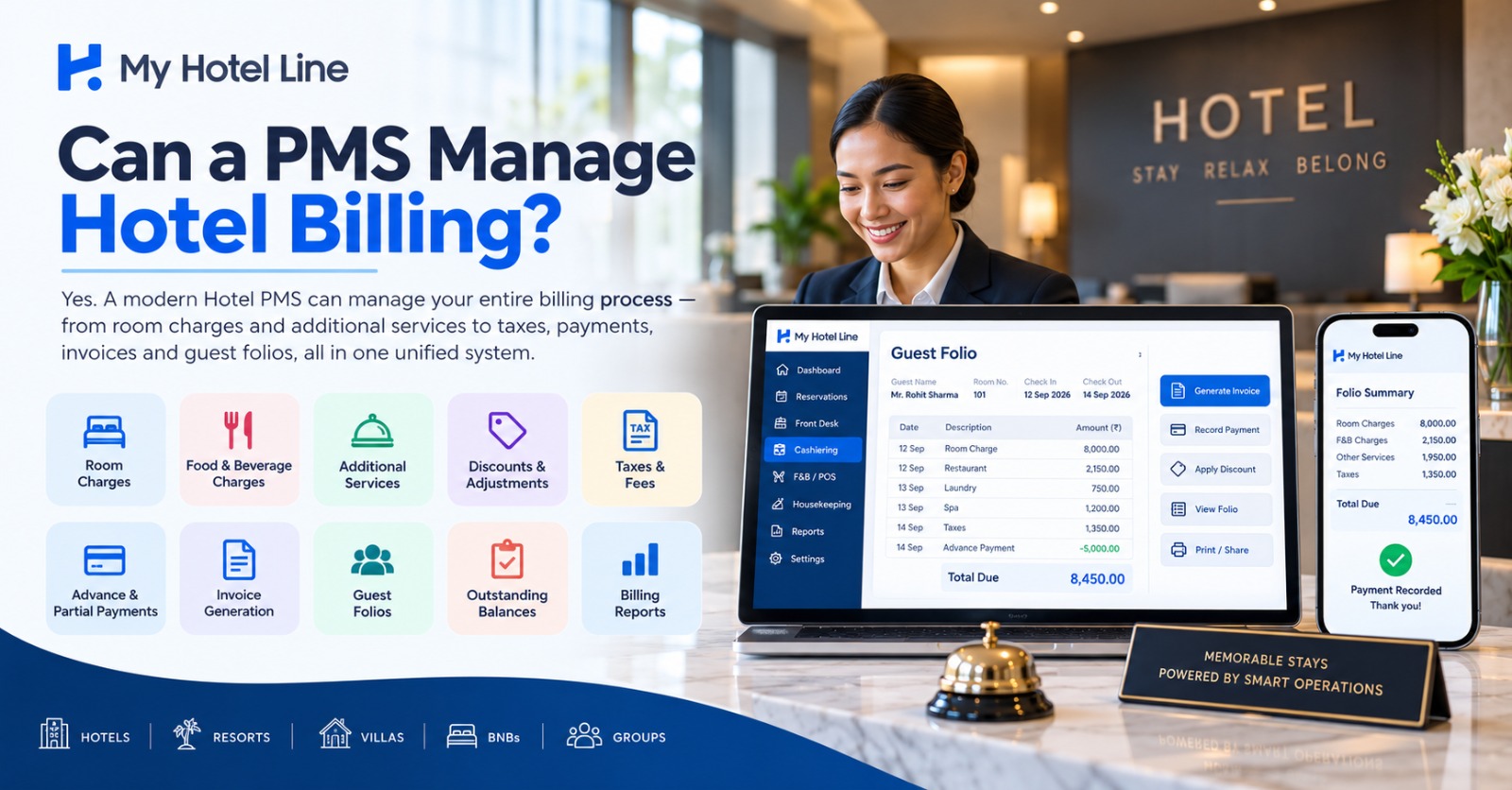
Can a PMS Manage Hotel Billing?
Yes, a modern Hotel Property Management System (PMS) can manage many hotel billing activities, including room charges, additional services, taxes, discounts, payments, invoices, and guest folios. Instead of maintaining billing information separately from reservations and front-desk operations, a PMS can connect guest stays, room charges, and payments in one centralized system.
For hotels, resorts, villas, BnBs, and other accommodation businesses, an integrated PMS such as MyHotelLine can help simplify billing by connecting reservations, guest information, room inventory, charges, and payment records.
What Is Hotel Billing in a PMS?
Hotel billing is the process of recording and managing all charges associated with a guest's stay and generating the final bill or invoice.
A Hotel PMS can bring different billing activities together, including:
- Room and accommodation charges
- Food and beverage charges
- Additional hotel services
- Discounts and adjustments
- Taxes and applicable charges
- Advance payments
- Partial and final payments
- Guest folios
- Invoice generation
- Outstanding balances
- Billing reports
This means hotel staff do not necessarily need to calculate every charge manually or maintain separate spreadsheets for each guest.
How Does a PMS Manage Hotel Billing?
A PMS generally connects billing with the guest's reservation and stay information.
For example, when a guest checks into a hotel, the PMS can create or update the guest's folio. The room rate and applicable charges can then be associated with the reservation. Additional services or transactions can be added to the same guest account.
At checkout, the hotel can review the complete folio, apply relevant adjustments, record the payment, and generate the final invoice.
This creates a more connected workflow:
Reservation → Check-in → Room Charges → Additional Charges → Payments → Invoice → Checkout
With MyHotelLine, hotel teams can manage core property operations through a centralized cloud-based hotel management platform rather than relying on disconnected systems.
What Hotel Charges Can a PMS Track?
A PMS can be used to organize different types of guest charges depending on the hotel's configuration and the capabilities of the software.
Room Charges
Room charges are normally the primary component of a hotel guest bill. A PMS can associate the applicable room rate with the reservation and guest stay.
Depending on the property's pricing structure, this may include different room types, rate plans, packages, seasonal pricing, or other configured charges.
Food and Beverage Charges
Hotels that connect restaurant or POS operations with their property management workflow can associate eligible food and beverage transactions with a guest account.
For example, a restaurant charge can be posted to the guest's room account and included in the final folio.
Additional Services
Guests may use services such as laundry, spa, transportation, activities, or other hotel facilities.
A connected PMS can help staff record these additional charges against the appropriate guest account.
Taxes and Other Charges
A PMS can apply configured taxes, fees, or other charges to eligible transactions according to the hotel's billing setup and applicable requirements.
Because tax rules can vary by location and business type, hotels should configure their billing system according to applicable local regulations and accounting requirements.
Discounts and Adjustments
Hotels frequently need to apply discounts, corrections, complimentary services, or other billing adjustments.
A PMS can provide staff with a centralized record of these changes, helping reduce manual calculations and billing discrepancies.
Can a PMS Generate Hotel Invoices?
Yes. Hotel PMS software can generate invoices or billing documents based on the guest's folio and recorded transactions.
Instead of preparing a guest bill manually, staff can review the charges recorded during the stay and generate the applicable invoice from the system.
A well-configured billing workflow can include:
Guest details + Room charges + Additional services + Taxes + Discounts + Payments = Final guest invoice
This can make the checkout process faster and provide hotel staff with a clearer record of the transaction.
Can a PMS Manage Guest Payments?
Yes, many PMS platforms support payment recording and payment-related workflows.
Depending on the PMS and its integrations, hotel staff may be able to record:
- Advance payments
- Cash payments
- Card payments
- Online payments
- Partial payments
- Refunds or adjustments
- Outstanding balances
The exact payment functionality depends on the PMS, payment gateway, POS integrations, and the hotel's configuration.
What Is a Guest Folio in a Hotel PMS?
A guest folio is the financial record associated with a guest's stay.
It can contain the transactions that contribute to the guest's final balance, such as:
Room charges + Taxes + Food & Beverage + Services + Discounts − Payments = Balance Due
A PMS helps keep these transactions associated with the correct reservation or guest account.
This is particularly useful for hotels because billing information remains connected to the guest's stay instead of being maintained separately.
Can a PMS Handle Group Billing?
A PMS may also support billing workflows for groups, corporate bookings, and other multi-room reservations, depending on its functionality.
For example, a hotel may need to separate charges between:
- Individual guests
- Company accounts
- Group organizers
- Corporate billing accounts
- Direct-pay guests
A PMS with group and billing functionality can help hotel staff organize these transactions and reduce the amount of manual reconciliation required.
Can Hotel PMS Billing Reduce Manual Work?
One of the main advantages of connecting billing with a PMS is reducing repetitive manual work.
Without an integrated system, hotel staff may need to move information between reservation software, spreadsheets, accounting systems, POS systems, and payment records.
A connected PMS can centralize much of this information.
This can help hotels:
- Reduce duplicate data entry
- Minimize billing calculation errors
- Speed up guest checkout
- Improve transaction visibility
- Maintain better guest records
- Simplify daily reconciliation
- Access billing information from a centralized system
How Does MyHotelLine Help With Hotel Billing?
MyHotelLine is a cloud-based hotel management platform designed to bring important hotel operations into one connected environment.
Its hotel technology ecosystem includes solutions for Hotel PMS, Booking Engine, Channel Manager, POS, ERP, reporting, and mobile hotel management, allowing properties to build a more connected operational workflow.
For billing-related operations, the value of a PMS is not simply generating a bill. The bigger advantage is connecting billing information with the guest's reservation, stay, room, services, and payment activity.
This gives hotel staff a more centralized view of the guest account and helps create a smoother front-desk and checkout experience.
Is a PMS Enough for Hotel Accounting?
Not necessarily. A PMS and accounting software can serve different purposes.
A PMS is primarily designed to manage hotel operations, reservations, guests, rooms, charges, payments, and related workflows. Accounting software is generally designed for broader financial accounting, bookkeeping, taxation, ledgers, and financial reporting.
For this reason, hotels may use a PMS alongside accounting software or integrate the two systems.
The right setup depends on the hotel's size, accounting requirements, integrations, and business processes.
What Should Hotels Look for in PMS Billing Software?
Before selecting a hotel PMS, hotel owners and managers should evaluate whether the system supports their specific billing workflow.
Important areas to consider include:
Integrated guest folio: Charges and payments should remain associated with the correct guest or reservation.
Invoice management: The system should make it easy to review charges and generate billing documents.
Multiple payment methods: Hotels should be able to record the payment methods relevant to their operations.
Tax configuration: The system should support the hotel's applicable tax and billing configuration.
POS integration: Hotels with restaurants or other outlets may benefit from connecting POS transactions with guest accounts.
Reporting: Managers should be able to review revenue, transactions, outstanding balances, and other operational information.
Cloud accessibility: Cloud-based systems can provide authorized staff with access to hotel operations across supported devices and locations.
Ease of use: Front-desk staff should be able to complete billing and checkout workflows without unnecessary complexity.
Frequently Asked Questions
Can a hotel PMS manage billing?
Yes. A hotel PMS can manage room charges, guest folios, additional services, payments, taxes, discounts, invoices, and billing records, depending on the system's capabilities.
Can a PMS generate hotel invoices?
Yes. A PMS can generate invoices or billing documents using the transactions recorded against a guest reservation or folio.
Can a PMS track hotel payments?
Yes. PMS software can record payments and outstanding balances, with the exact payment functionality depending on the PMS and its integrations.
Can restaurant charges be added to a hotel bill?
Yes, when the hotel's POS and PMS support the appropriate integration, restaurant or other outlet charges can be posted to a guest's folio.
Can a PMS manage taxes on hotel bills?
A PMS can support configured taxes and charges. Hotels should ensure the configuration reflects the tax rules applicable to their location and business.
Is hotel PMS the same as accounting software?
No. A PMS focuses primarily on hotel operations and guest transactions, while accounting software is designed for broader financial accounting and bookkeeping functions. Hotels may use both systems together.
Does MyHotelLine provide hotel PMS software?
Yes. MyHotelLine provides a cloud-based Hotel PMS solution designed to help hotels manage property operations, reservations, guest information, and connected workflows from a centralized platform.
Final Answer: Can a PMS Manage Hotel Billing?
Yes, a modern Hotel Property Management System can manage hotel billing as part of an integrated property-management workflow. It can connect room charges, guest folios, additional services, taxes, discounts, payments, invoices, and reporting with the guest's reservation and stay.
For hotels looking to reduce manual billing work and connect front-desk operations with other hotel processes, a cloud-based PMS such as MyHotelLine can provide a centralized technology platform for managing day-to-day hotel operations.
If your goal is to simplify hotel billing while keeping reservations, guests, rooms, payments, and operational data connected, a PMS is generally more effective than using standalone billing software.
We are trusted by over X+ properties in X countries. It’s your turn now!


