
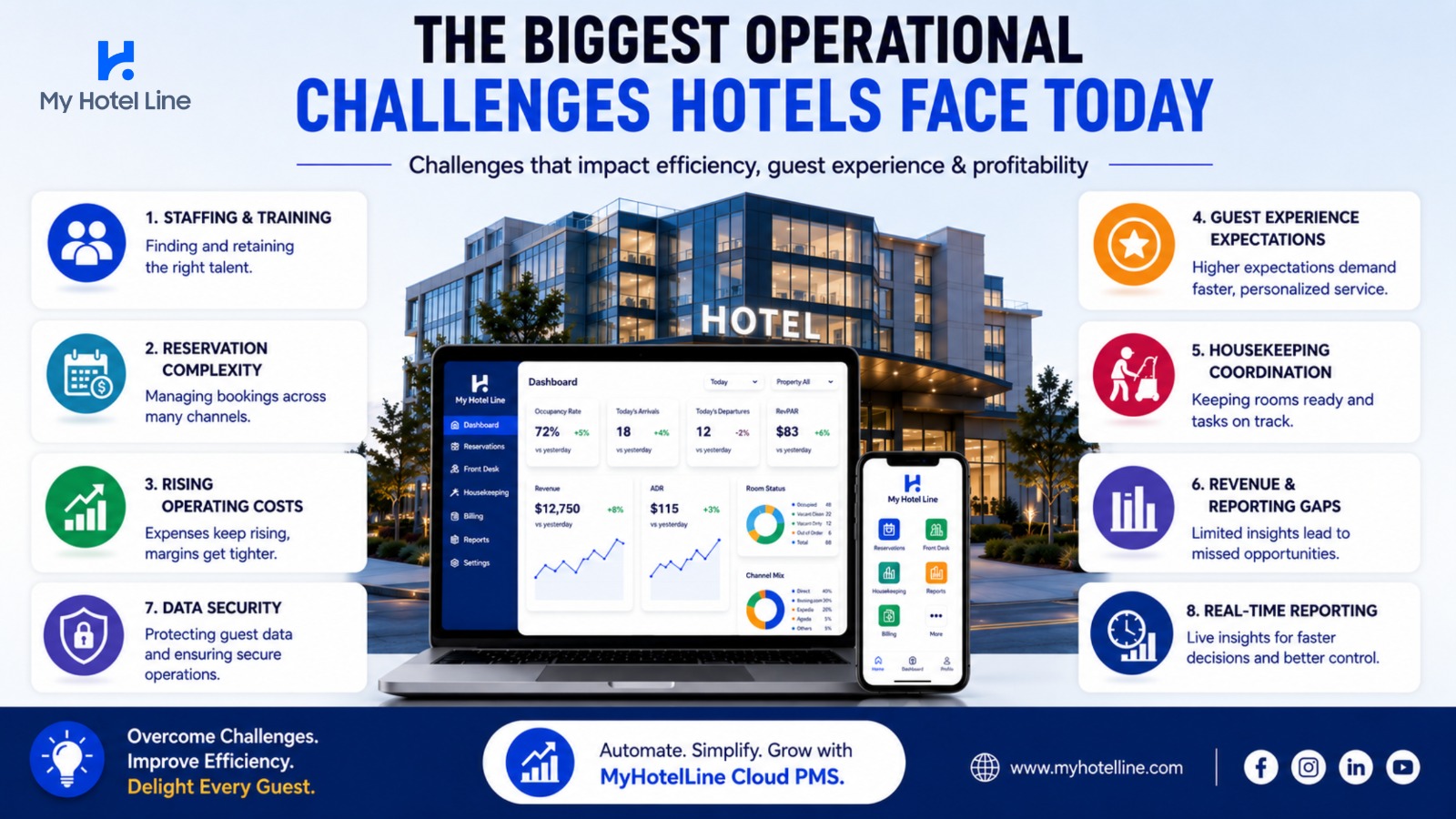
The Biggest Operational Challenges Hotels Face Today
The hospitality industry has undergone significant transformation over the past decade. Guest expectations have evolved, technology has become essential, online booking platforms dominate reservations, and competition has intensified across every hotel category. Whether it's a boutique hotel, business hotel, luxury resort, serviced apartment, or homestay, every property faces operational challenges that directly affect profitability and guest satisfaction.
Today's guests expect instant booking confirmations, seamless check-ins, personalized services, fast responses, and contactless experiences. Meanwhile, hotel owners must manage reservations from multiple channels, coordinate housekeeping teams, optimize room occupancy, maintain service quality, control operational costs, and ensure staff productivity—all while delivering exceptional hospitality.
Many hotels still rely on manual processes, spreadsheets, or outdated software that cannot keep pace with these growing demands. As a result, they experience booking errors, communication gaps, inefficient workflows, revenue leakage, and dissatisfied guests.
Fortunately, modern Hotel Management Software has transformed hotel operations by automating routine tasks, improving communication between departments, and providing real-time visibility into business performance.
In this article, we'll explore the biggest operational challenges hotels face today and explain how technology helps overcome them.
Why Hotel Operations Have Become More Complex
Managing a hotel today is far more demanding than it was just a few years ago. Hotels are expected to operate around the clock while delivering consistent service across multiple departments.
Several factors have contributed to this complexity:
- Rising guest expectations
- Increased online competition
- Multiple booking channels
- Higher operating expenses
- Staff shortages
- Technology adoption
- Growing dependence on Online Travel Agencies (OTAs)
- Demand for real-time reporting
Without the right systems in place, these challenges can quickly affect efficiency, profitability, and customer satisfaction.
1. Staff Shortages and Workforce Management
One of the biggest challenges facing the hospitality industry is recruiting and retaining skilled employees.
Hotels require trained professionals for:
- Front Office
- Housekeeping
- Reservations
- Food & Beverage
- Maintenance
- Sales & Marketing
- Accounts
Unfortunately, many hotels struggle with high employee turnover, seasonal staffing shortages, and increasing labor costs.
When teams are understaffed, employees often manage multiple responsibilities, resulting in:
- Longer guest waiting times
- Delayed room cleaning
- Increased employee stress
- Lower service quality
- Reduced productivity
How Hotel Management Software Helps
Modern Hotel Management Software automates repetitive tasks such as reservations, billing, room allocation, reporting, and guest communication. This reduces manual workload, allowing staff to focus on delivering excellent guest experiences instead of handling paperwork.
2. Managing Reservations Across Multiple Booking Channels
Today's hotels rarely receive bookings from just one source.
Reservations may arrive through:
- Hotel website
- Booking.com
- Agoda
- Expedia
- MakeMyTrip
- Goibibo
- Corporate clients
- Travel agents
- Walk-in guests
- Phone enquiries
Without automated synchronization, staff must manually update room inventory after every booking.
This often causes:
- Double bookings
- Incorrect room availability
- Missed reservations
- Revenue loss
- Guest dissatisfaction
Why This Is a Major Challenge
As occupancy increases, manually updating multiple booking channels becomes nearly impossible. Even a small delay can result in overbookings and costly guest compensation.
The Solution
A Hotel Management System integrated with a Channel Manager automatically synchronizes room availability and rates across all booking platforms in real time. This eliminates manual updates, reduces booking errors, and helps maximize occupancy.
3. Rising Operational Costs
Operating a hotel has become increasingly expensive.
Hotels must manage costs related to:
- Employee salaries
- Utilities
- Building maintenance
- Housekeeping supplies
- Food and beverage operations
- Marketing
- OTA commissions
- Technology upgrades
When daily operations rely on manual processes, costs increase even further due to inefficiencies and wasted staff hours.
Common Cost-Related Problems
- Time spent on repetitive administrative tasks
- Manual reporting
- Incorrect billing
- Resource wastage
- Poor inventory control
- Revenue leakage
How Technology Reduces Costs
Cloud-based Hotel Management Software automates daily operations, improves staff productivity, reduces administrative work, and minimizes costly human errors. This helps hotels optimize resources and improve overall profitability.
4. Delivering Exceptional Guest Experiences
Guest expectations have never been higher.
Modern travelers expect hotels to provide:
- Instant booking confirmations
- Quick check-in and check-out
- Contactless payment options
- Personalized services
- Fast issue resolution
- Digital invoices
- Consistent communication
A single negative experience can lead to poor online reviews, lower ratings, and lost future bookings.
Hotels using manual systems often struggle to meet these expectations because staff spend too much time managing operational tasks instead of interacting with guests.
How Hotel Management Software Improves Guest Satisfaction
A modern Property Management System (PMS) enables hotels to:
- Speed up check-ins and check-outs
- Maintain accurate guest profiles
- Personalize guest services
- Improve response times
- Reduce booking errors
- Simplify billing
This allows staff to focus on hospitality rather than paperwork, creating memorable guest experiences that encourage repeat visits and positive reviews.
5. Revenue Management and Maximizing Occupancy
Revenue management is one of the most important aspects of running a successful hotel. Every vacant room represents lost revenue, while incorrect pricing can reduce profitability even when occupancy is high.
Hotels today must constantly balance room rates with market demand, seasonal trends, local events, and competitor pricing.
Common revenue management challenges include:
- Low occupancy during off-seasons
- Overpricing or underpricing rooms
- Last-minute cancellations
- Revenue leakage
- Poor forecasting
- Inaccurate occupancy reports
Many hotels still using spreadsheets struggle to monitor these factors in real time, making it difficult to optimize pricing strategies.
How Hotel Management Software Helps
Modern Hotel Management Software provides real-time occupancy reports, booking trends, revenue analytics, ADR (Average Daily Rate), and RevPAR (Revenue Per Available Room). These insights help hotel managers make informed pricing decisions that maximize occupancy and profitability.
6. Housekeeping Coordination and Room Readiness
Housekeeping is one of the busiest departments in any hotel. Efficient coordination between housekeeping and the front office is essential for maintaining guest satisfaction.
Without a centralized system, communication delays often occur.
Common housekeeping challenges include:
- Delayed room cleaning
- Rooms marked available before cleaning
- Poor communication with reception
- Missed maintenance requests
- Difficulty assigning housekeeping staff
- Slow room turnover
These issues can delay guest check-ins and reduce operational efficiency.
The Solution
A cloud-based Hotel PMS enables housekeeping staff to update room status instantly using mobile devices or dedicated dashboards. Reception can immediately see which rooms are clean, occupied, under maintenance, or ready for new guests.
This improves coordination, reduces waiting times, and enhances the overall guest experience.
7. Manual Billing and Financial Errors
Hotel billing has become increasingly complex. In addition to room charges, hotels often manage:
- Restaurant bills
- Laundry services
- Spa services
- Mini-bar consumption
- Transportation
- Event bookings
- Taxes and GST
- Discounts and promotional offers
Managing these transactions manually increases the likelihood of errors.
Common billing issues include:
- Incorrect invoices
- Missing service charges
- Wrong tax calculations
- Duplicate billing
- Payment reconciliation problems
These mistakes can result in financial losses and dissatisfied guests.
How Automation Improves Billing
Hotel Management Software automatically generates invoices, applies taxes accurately, records payments, and integrates billing across departments. This reduces errors, speeds up check-outs, and ensures transparent financial records.
8. Dependence on Online Travel Agencies (OTAs)
Online Travel Agencies such as Booking.com, Agoda, Expedia, MakeMyTrip, and Goibibo help hotels reach a larger audience. However, relying too heavily on OTAs can reduce profit margins because of commission fees.
Hotels that depend entirely on third-party booking platforms often face challenges such as:
- High commission costs
- Reduced direct bookings
- Limited customer ownership
- Increased competition
- Lower profitability
The Better Approach
Modern Hotel Management Software includes an integrated Online Booking Engine that allows guests to book directly through the hotel's website. Direct bookings reduce commission expenses, improve profitability, and help hotels build stronger relationships with guests.
9. Data Security and Business Continuity
Hotels store valuable information every day, including guest details, payment records, invoices, reservation history, and business reports.
Using spreadsheets or outdated software exposes hotels to risks such as:
- Data loss
- File corruption
- Accidental deletion
- Unauthorized access
- Hardware failure
- Incomplete backups
Losing operational data can seriously affect business continuity and customer trust.
Cloud-Based Security
Cloud Hotel Management Software stores information securely using encrypted servers, automatic backups, role-based access controls, and disaster recovery systems. Hotel owners can access business information safely from anywhere while ensuring guest data remains protected.
10. Lack of Real-Time Business Insights
Successful hotel management depends on making informed decisions based on accurate and up-to-date information.
Hotel owners need instant answers to questions like:
- What is today's occupancy rate?
- Which room categories perform best?
- Which booking channels generate the most revenue?
- What is today's ADR?
- What is the RevPAR?
- How much revenue has been generated today?
- Which guests are checking in and checking out?
Preparing these reports manually using spreadsheets is time-consuming and often results in outdated information.
Smart Reporting with Hotel Management Software
Modern Hotel Management Software provides real-time dashboards that display occupancy, revenue, booking trends, room performance, financial reports, and operational KPIs. This enables managers to make faster, data-driven decisions that improve hotel performance.
How Hotel Management Software Solves These Challenges
The challenges facing hotels today are complex, but they are not impossible to overcome. The right technology can simplify operations, improve efficiency, reduce costs, and deliver better guest experiences.
A modern Hotel Management Software (HMS) integrates all hotel departments into one centralized platform, allowing owners and staff to manage daily operations more efficiently.
Instead of relying on multiple spreadsheets or disconnected systems, hotels can automate reservations, billing, housekeeping, reporting, and guest communication from a single dashboard.
Key advantages include:
- Automated reservation management
- Real-time room inventory
- Faster check-in and check-out
- Online Booking Engine
- Channel Manager integration
- Automated billing and invoicing
- Housekeeping management
- Guest Relationship Management (CRM)
- Revenue analytics
- Mobile accessibility
- Secure cloud storage
With automation handling routine tasks, hotel staff can focus on delivering outstanding hospitality.
Why Cloud-Based Hotel Management Software Is the Future
The hospitality industry is becoming increasingly digital. Hotels that continue relying on manual processes risk falling behind competitors who have adopted cloud technology.
Cloud-based Hotel Management Software offers several advantages:
- Access from anywhere
- Automatic software updates
- Secure cloud backup
- Reduced IT maintenance
- Multi-property management
- Better scalability
- Improved collaboration between departments
- Higher operational efficiency
Whether managing one hotel or an entire chain, cloud technology enables businesses to grow without operational limitations.
Conclusion
Running a hotel today involves much more than managing reservations. Hotel owners must coordinate multiple departments, maintain high service standards, control operational costs, manage online bookings, protect guest data, and make quick business decisions in an increasingly competitive market.
Manual systems and spreadsheets can no longer keep pace with these demands. They often result in booking errors, communication gaps, delayed operations, inaccurate reporting, and lost revenue.
Modern Hotel Management Software addresses these challenges by automating daily operations, improving collaboration, providing real-time business insights, and enhancing the overall guest experience.
Hotels that invest in digital transformation are better equipped to improve efficiency, increase occupancy, reduce costs, and build long-term guest loyalty.
We are trusted by over X+ properties in X countries. It’s your turn now!


