
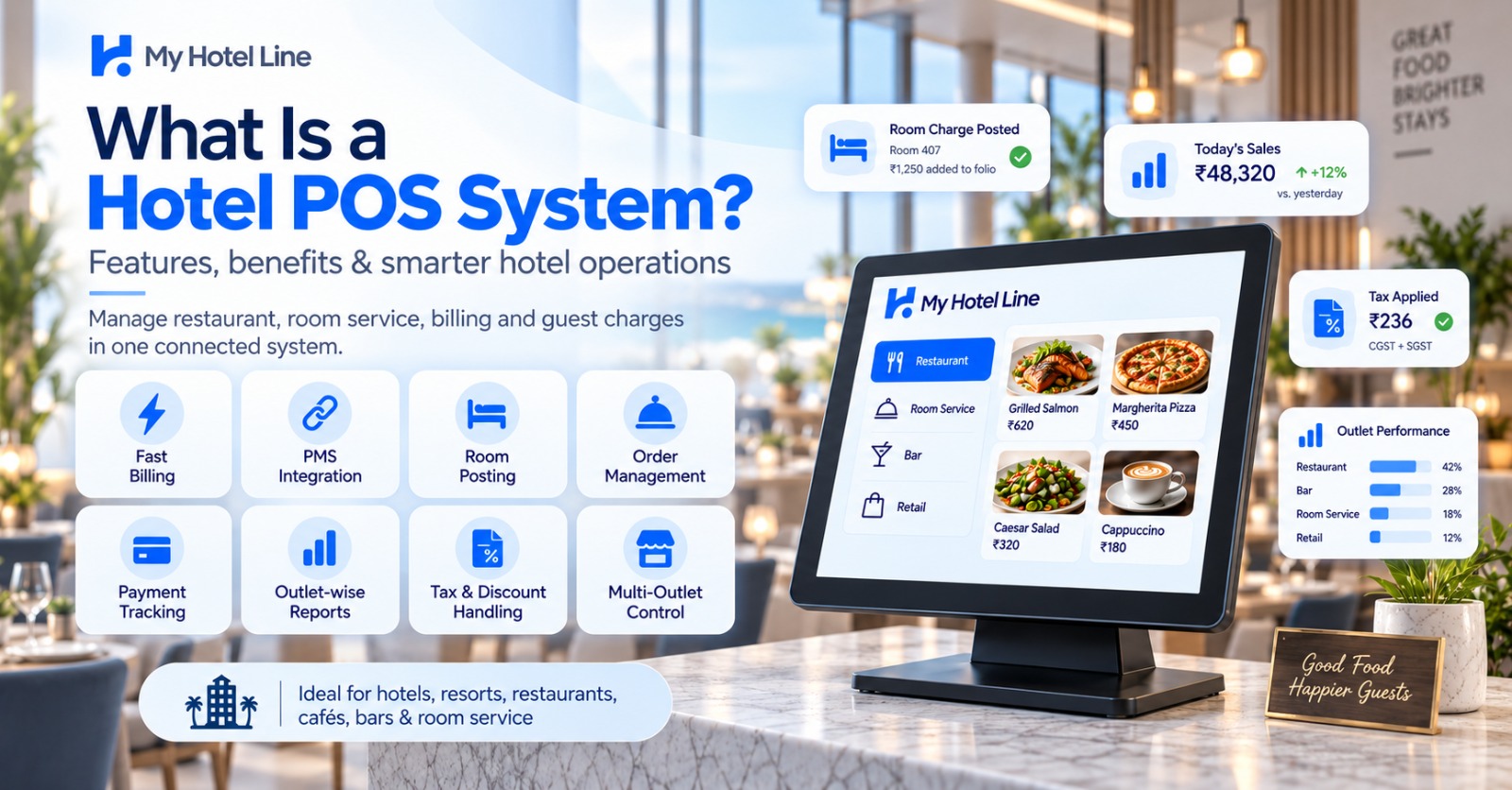
What Is a Hotel POS System?
A hotel POS (Point of Sale) system is software that helps hotels, resorts, restaurants, cafés, bars, and other hospitality businesses manage sales, payments, orders, and transactions from a centralized system. Instead of handling restaurant bills, room-service orders, café purchases, or other guest charges manually, a hotel POS system records each transaction digitally and helps staff process payments accurately and efficiently. When integrated with a hotel Property Management System (PMS), the POS can also connect guest purchases with room reservations and folios, creating a more connected hotel operation.
For hotels, a POS system is more than a digital billing tool. It can connect different revenue-generating outlets such as restaurants, bars, cafés, room service, banquets, and other hotel facilities. Staff can create orders, generate bills, apply discounts, process payments, and maintain transaction records through a centralized platform. This gives hotel managers better visibility into sales performance while reducing manual work and billing errors.
How Does a Hotel POS System Work?
A hotel POS system works by recording transactions whenever a guest purchases a product or service at a hotel outlet. For example, when a guest orders food at a hotel restaurant, the staff can enter the order into the POS system. The system records the items, calculates taxes and applicable discounts, generates the bill, and processes the payment. If the POS is integrated with the hotel's PMS, the restaurant bill can also be posted directly to the guest's room folio, allowing the guest to settle the restaurant and accommodation charges together during checkout.
This connected workflow can make daily hotel operations easier because sales information does not have to be entered repeatedly into different systems. Hotel managers can also use POS reports to monitor outlet sales, popular products, payment methods, discounts, taxes, and other important business information.
Why Is a POS System Important for Hotels?
A hotel POS system helps hospitality businesses manage multiple sales points while maintaining accurate transaction records. Hotels often operate several outlets simultaneously, and manually managing orders and billing across restaurants, bars, cafés, room service, and banquet operations can become difficult as the business grows.
With a centralized POS solution such as MyHotelLine, hotel staff can manage transactions more systematically while managers gain a clearer view of outlet performance. The system can help reduce repetitive data entry, improve billing accuracy, simplify payment processing, and support better financial reporting.
Another important advantage is the connection between the POS and the hotel's PMS. When these systems work together, guest purchases can be associated with the correct room and reservation. This creates a smoother experience for both hotel employees and guests because charges can be posted to the guest's folio without requiring separate manual entries.
Key Features of a Hotel POS System
A modern hotel POS system typically includes features for order management, billing, payment processing, tax calculation, discounts, outlet management, reporting, and inventory-related operations. Depending on the solution, hotels can also manage restaurant tables, menus, room-service orders, multiple payment methods, and staff permissions from the same platform.
For example, MyHotelLine POS can be positioned as part of an integrated hotel technology ecosystem where POS operations work alongside hotel PMS, booking, and other operational functions. This approach allows hotels to reduce disconnected processes and maintain more consistent operational data across departments.
Hotel POS and PMS Integration
One of the most useful capabilities of a hotel POS system is its integration with a hotel PMS. A PMS manages core hotel activities such as reservations, check-ins, check-outs, room assignments, guest information, and folios, while the POS manages sales and transactions at hotel outlets.
When the two systems are connected, a guest can order a meal at the hotel restaurant and request the charge to be added to their room. The POS records the transaction and transfers the charge to the appropriate guest folio in the PMS. At checkout, the accommodation and outlet charges can therefore be managed as part of the same guest account.
This type of integration is particularly useful for hotels with restaurants, bars, cafés, room service, banquet facilities, or multiple revenue-generating outlets because it creates a more connected flow of information between departments.
How Can a Hotel POS System Improve Guest Experience?
A well-designed hotel POS system can improve the guest experience by making ordering and payment processes faster and more convenient. Staff can access orders quickly, generate accurate bills, accept different payment methods, and post eligible charges directly to guest rooms when the POS is integrated with the PMS.
For example, a guest staying at a hotel can order room service without needing to make a separate payment immediately. The room-service transaction can be recorded through the POS and posted to the guest's room folio. This provides a more convenient experience and allows the guest to manage multiple hotel expenses through a single account.
How Does a Hotel POS System Help Increase Revenue?
A POS system can support hotel revenue management by providing detailed information about sales across different outlets. Hotel managers can identify which menu items are selling frequently, which outlets are generating more revenue, and how sales change during different periods.
This information can help hotels make better decisions about menu planning, promotions, pricing, inventory purchasing, and staffing. POS data can also help identify opportunities for cross-selling and upselling. For instance, hotels can promote popular food combinations, beverage add-ons, special packages, or outlet-specific offers based on purchasing patterns.
When POS data is connected with other hotel systems, management can gain a broader understanding of guest spending and overall property performance rather than looking at individual transactions in isolation.
Hotel POS System for Restaurants, Bars and Room Service
A hotel POS system is useful across different hospitality outlets. In restaurants, it can manage tables, orders, menu items, billing, taxes, and payments. In bars and cafés, it can record beverage and food sales while maintaining accurate transaction records. For room service, it can help staff manage guest orders and connect charges with the appropriate room when integrated with the PMS.
For hotels with banquet halls or event facilities, a POS system can also support billing for food, beverages, packages, and other services. A centralized system makes it easier for management to monitor revenue generated across different departments.
What Should Hotels Look for in a POS System?
Hotels choosing a POS system should consider usability, PMS integration, billing capabilities, payment processing, reporting, outlet management, scalability, security, and the ability to support their specific hospitality operations. The system should be simple enough for employees to learn quickly while providing managers with the information required to monitor business performance.
Integration is particularly important for hotels because a POS should not operate as an isolated billing application. A connected solution can reduce duplicate data entry and allow information to move more efficiently between the POS, PMS, inventory, accounting, and other hotel systems.
Why Choose MyHotelLine for Hotel POS Management?
MyHotelLine is designed as a hotel technology platform that brings important hospitality operations together through solutions such as Hotel PMS, Booking Engine, Channel Manager, POS, and mobile hotel management tools. By connecting these functions, hotels can manage reservations, guest operations, sales, and distribution through a more integrated technology environment.
For a hotel that operates restaurants, cafés, bars, room service, or multiple outlets, integrating POS functionality with the broader MyHotelLine hotel management ecosystem can help create a more efficient operational workflow. Instead of maintaining disconnected systems for different departments, hotel teams can work with connected technology designed specifically for hospitality businesses.
Frequently Asked Questions About Hotel POS Systems
What is a hotel POS system?
A hotel POS system is software used to manage sales, orders, billing, and payments across hotel outlets such as restaurants, bars, cafés, room service, and banquet facilities. When integrated with a hotel PMS, it can also post guest purchases directly to room folios.
What is the difference between a hotel POS and a hotel PMS?
A hotel PMS primarily manages accommodation operations such as reservations, guest profiles, room assignments, check-ins, check-outs, and folios. A hotel POS manages sales, orders, billing, and payments at hotel outlets. Integrating both systems allows guest and outlet transactions to work together.
Can a hotel POS system integrate with a PMS?
Yes. PMS integration allows restaurant, bar, café, and room-service charges to be associated with guest rooms and reservations. This can reduce manual data entry and make billing more convenient.
Is a hotel POS useful for small hotels?
Yes. A POS can be useful for small hotels that operate restaurants, cafés, bars, room service, or other paid facilities. The main benefit is centralized transaction management and more accurate billing and reporting.
Does a hotel POS system help increase revenue?
A POS system can support revenue growth by providing sales data that helps hotel managers understand outlet performance, popular products, customer purchasing patterns, and opportunities for upselling or promotions.
Can MyHotelLine POS be used with other hotel operations?
Yes. MyHotelLine is positioned as an integrated hotel technology platform combining functions such as PMS, booking engine, channel management, POS, and other hotel-management capabilities. This helps hotels manage different operational areas through a connected technology ecosystem.
Final Takeaway
A hotel POS system is an important part of modern hotel technology because it connects sales, ordering, billing, payments, and outlet operations in one digital workflow. When integrated with a hotel PMS, it can go beyond basic billing by connecting restaurant and other outlet transactions with guest reservations and room folios.
For hotels looking to simplify operations, improve billing accuracy, understand outlet performance, and provide a smoother guest experience, an integrated solution such as MyHotelLine can provide a practical approach to managing POS and wider hotel operations from a connected platform.
We are trusted by over X+ properties in X countries. It’s your turn now!


